
Level I – Introductory Lineman Program

Ray Gillette
Course Overview
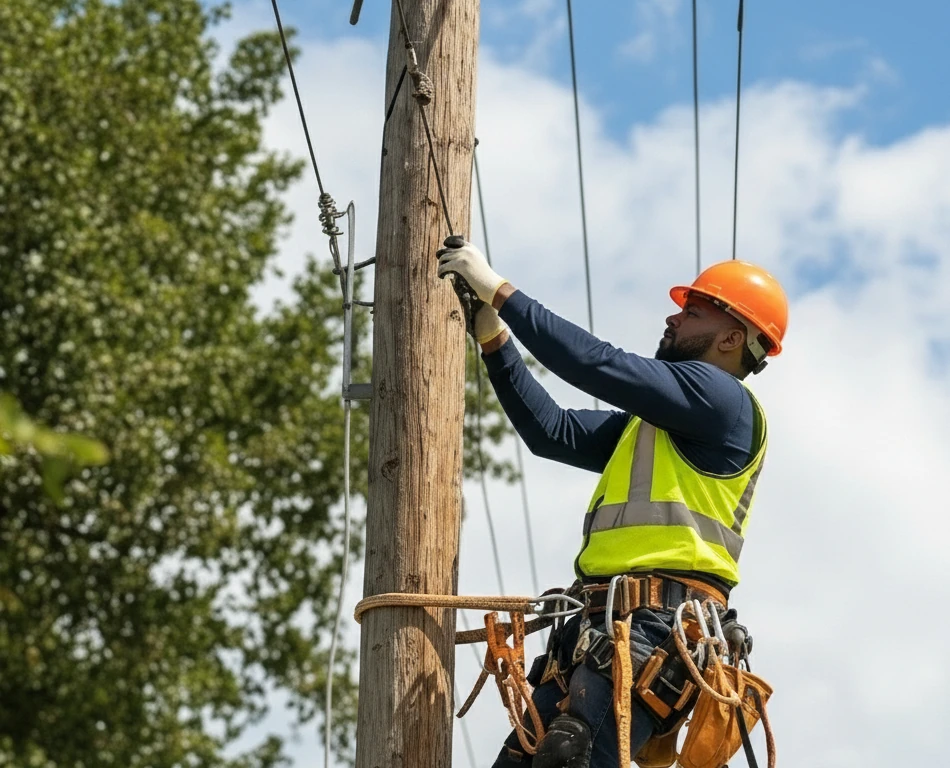
This course introduces trainees to the fundamentals of the lineman trade with a strong focus on safety, compliance, and basic field skills. The curriculum is designed to provide trainees with knowledge of the National Electrical Code (NEC) and the National Electrical Safety Code (NESC), proper use of Personal Protective Equipment (PPE), climbing, and rigging basics. This introductory level blends classroom instruction with labs and field simulations, ensuring graduates are prepared for supervised entry-level field work.
Learning Outcomes:
Trainees completing Level I should be able to demonstrate the following competencies:
- Explain differences between the NEC and NESC.
- Identify regulatory bodies, such as OSHA, NFPA, and IEEE.
- Describe career pathways within the lineman trade.
- Correctly select and use PPE.
- Identify at least 10 common jobsite hazards.
- Demonstrate fall protection system setup.
- Operate aerial lifts in accordance with OSHA and NESC standards.
- Perform CPR and use an AED confidently.
- Execute pole-top rescue procedures.
- Apply NEC Article 230 rules to service installations.
- Measure and verify NESC clearances.
- Identify noncompliant service drops.
- Apply NEC grounding and bonding rules (Article 250).
- Calculate pole loading using NESC formulas.
- Demonstrate correct wiring method selection (NEC 300).
- Identify and maintain lineman tools.
- Tie required knots (e.g., bowline, clove hitch, square knot).
- Inspect ropes and blocks.
- Use insulated tools correctly.
- Set a pole using proper rigging techniques.
- Inspect poles for decay or defects for safety.
- Demonstrate safe climbing techniques.
- Install pole hardware, such as crossarms and insulators.
- Handle conductors safely.
- Perform the full scope of Level I tasks safely and accurately, demonstrating readiness for workforce entry.
Core Topics:
Module 1 – Orientation & Industry Standards
- NEC Article 90: Purpose, scope, and application to line work.
- NESC Section 1: Scope and application in overhead & underground systems.
- OSHA 1910.269 overview: Power generation, transmission, and distribution.
- Industry pathways: Apprentice -> Journeyman -> Foreman -> Supervisor.
- Guyana’s electrical grid: Current infrastructure and workforce demand.
Module 2 – OSHA Safety & Hazard Awareness
- OSHA Subpart V: Power line safety rules.
- NEC 110.16: Arc flash warnings and PPE requirements.
- NESC Section 42: General safety rules for employees.
- Fall protection standards and ladder safety.
- Hazard communication and lockout/tagout basics.
Module 3 – Equipment Safety & Emergency Response
- OSHA 1926.453: Aerial lifts and bucket truck operations.
- NESC Section 44: Protective grounding and clearances.
- OSHA 1910.151: First aid and emergency response requirements.
- Common emergencies, including electrical contact, falls, and vehicular impact.
Module 4 – NEC/NESC Applications I
- NEC Article 230: Service conductors and clearances.
- NESC Section 23: Vertical and horizontal conductor clearance tables.
- Basic service entrance equipment overview.
Module 5 – NEC/NESC Applications II
- NEC 250: Grounding and bonding rules.
- NEC 300: Wiring methods in line construction.
- NESC Section 24: Pole strength and loading.
- NESC Section 35: Underground system overview.
Module 6 – Tools & Rigging I
- NEC 110.21 equipment markings.
- Introduction to lineman hand tools (pliers, wrenches, cutters).
- Rigging basics: ropes, knots, and blocks.
Module 7 – Tools & Rigging II
- OSHA 1910.269(j): Insulated tool requirements.
- Hot stick inspection and safe use.
- Pole-setting equipment and practices.
Module 8 – Pole Climbing I
- NESC Rule 214: Pole inspection rules.
- Gaffs, belts, harnesses: fitting and inspection.
- Basic climbing techniques.
Module 9 – Pole Climbing II & Field Skills
- NEC 314: Boxes and enclosures.
- NESC 261/262: Conductor stringing and sagging basics.
- Hardware installation techniques.
Module 10 – Field Practicum & Final Assessment
- Integration of all Level I skills: OSHA, NEC/NESC, climbing, and rigging.
- Review and preparation for final exams.