
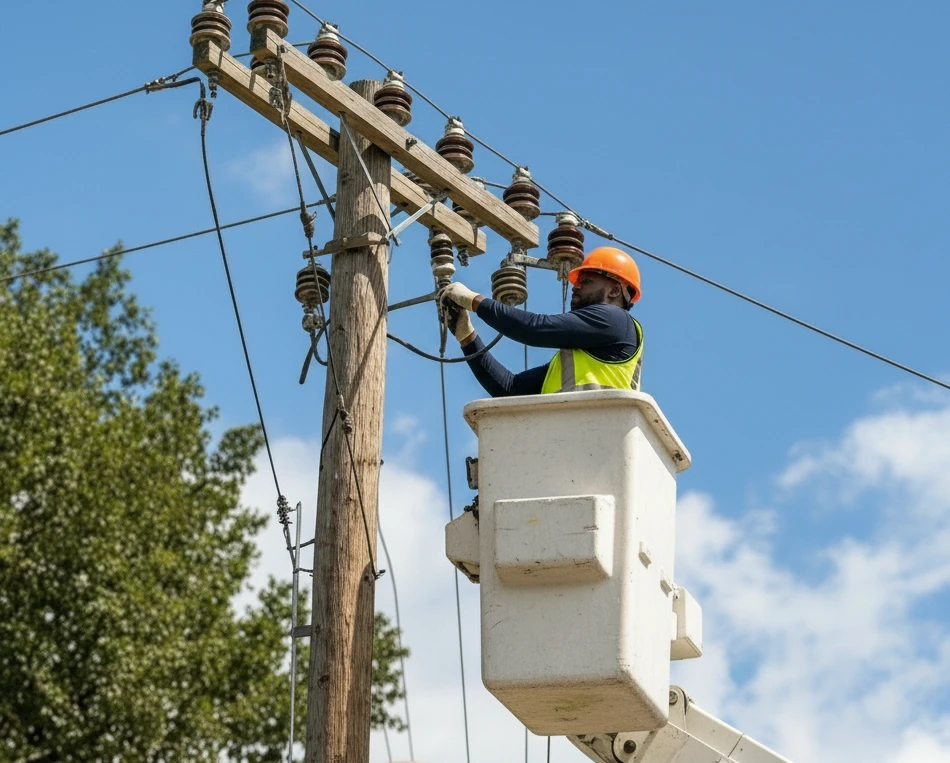
Level II – Intermediate Lineman Program

Ray Gillette
Course Overview
The course is designed to advance trainees with skills in energized line work, underground distribution, transformers, and system protection, with strict adherence to the National Electrical Code (NEC) and National Electrical Safety Code (NESC). This level emphasizes safety leadership through job hazard analysis and tailboard briefings, preparing students to take on greater responsibility in the field. By completion, graduates can perform intermediate line construction tasks, operate specialized equipment, and install key distribution devices, positioning them for advanced training and integration into the electrical workforce.
Learning Outcomes:
Trainees completing Level II should be able to demonstrate the following competencies:
- Apply OSHA 1910.269 provisions related to transmission and distribution.
- Lead a tailboard meeting effectively.
- Conduct hazard analysis for energized work.
- Perform pole-top rescue in 4 minutes or less.
- Demonstrate safe double pole climbing and transitioning techniques.
- Apply energized work positioning rules based on NESC Rule 420.
- Operate aerial lifts per OSHA/NESC requirements.
- Conduct comprehensive bucket truck inspections.
- Perform emergency evacuation from a lift.
- Calculate rigging loads accurately, accounting for safety factors.
- Apply proper guying and pole anchoring methods as defined by NESC Section 24.
- Safely set a transformer using appropriate rigging and hoisting methods.
- Frame poles correctly, including the installation of crossarms, insulators, and bracing.
- Verify conductor clearances using NESC Section 23 rules.
- Apply NEC/NESC rules pertaining to feeders and outside branch circuits (NEC 225).
- Install protective hardware correctly, such as cutouts, lightning arrestors, and reclosers.
- Sag conductors within 5% tolerance based on NESC 261/262 specifications.
- Demonstrate proper conductor splicing and dead-ending methods.
- Install conduits per NEC 300 depth and wiring method rules.
- Splice and terminate underground cable safely.
- Install pad-mounted equipment safely, following NESC Section 35 rules.
- Install single-phase transformers (NEC 450).
- Apply appropriate overcurrent and surge protection (NEC 240 & 280).
- Verify transformer polarity and continuity.
- Identify major substation components.
- Perform safe switching procedures and isolation sequences.
- Execute the energization sequence correctly.
- Complete a comprehensive line build project safely and accurately.
- Demonstrate code compliance in field construction.
Core Topics:
The Level II program is structured into modules focusing on advanced line construction practices:
Module 1 – Advanced Safety & Regulations
- OSHA 1910.269 advanced rules for transmission & distribution.
- NEC 110: Safe work practices, labeling, and identification.
- NESC Section 42: Employee safety rules in energized environments.
- Job Hazard Analysis (JHA) and Tailboard briefings.
- Crew communication and leadership in field safety.
Module 2 – Climbing & Rescue Techniques
- Pole-top rescue: methods and timing standards.
- Double pole climbing and transitioning techniques.
- Energized work positioning under NESC Rule 420.
- Advanced fall arrest & work positioning systems.
Module 3 – Aerial & Bucket Truck Operations
- OSHA 1926.453: Aerial lifts.
- NESC Section 44: Working clearances in elevated equipment.
- Emergency descent procedures.
- Bucket truck inspection, hydraulics, and safety protocols.
Module 4 – Advanced Rigging & Material Handling
- Rigging load calculations and safety factors.
- NESC Section 24: Guying and pole anchoring techniques.
- Transformer setting using blocks and hoists.
- Digger derrick rigging safety.
Module 5 – Overhead Line Construction I
- NEC 225: Feeders and outside branch circuits.
- NESC Section 23: Conductor clearance requirements.
- Pole framing: crossarms, insulators, and bracing.
- Phasing and load balance in distribution systems.
Module 6 – Overhead Line Construction II
- Installation of cutouts, lightning arrestors, and reclosers.
- NESC 261/262: Conductor stringing, sagging, and tensioning.
- Conductor splicing and dead-ending methods.
Module 7 – Underground Systems
- NEC 300: Conduits and wiring methods.
- NESC Section 35: Underground cable rules.
- Trenching, duct bank installation, and backfilling procedures.
- Pad-mounted equipment installation.
Module 8 – Transformers & Protection I
- NEC 450: Transformer installations.
- NEC 240 & 280: Overcurrent/surge protection.
- NESC Rule 410: Equipment grounding.
- Single-phase transformer sizing, polarity, and connections.
Module 9 – Transformers & Protection II
- Substation equipment overview.
- Switching devices and safety protocols.
- Energization sequences and isolation procedures.
- NEC/NESC integration for substation safety.
Module 10 – Field Practicum & Final Assessment
- Integration of advanced line work skills.
- Review of NEC/NESC compliance in field construction.
If Level I provided the foundational tools and techniques needed to be a supervised helper on the jobsite (learning the alphabet and basic grammar), **Level II teaches the lineman to construct the complex sentences and paragraphs of the electrical grid, safely and independently, by mastering specialized functions like setting the vital organs (transformers) and routing the circulatory system (underground cables)